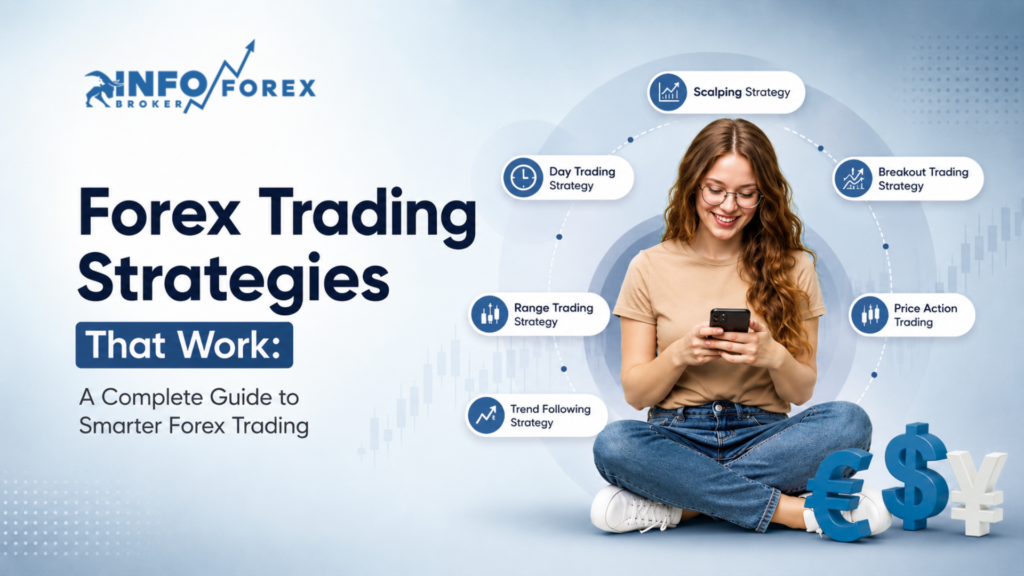
Do you also hear a lot about forex trading strategies, but have no clue what they actually are? A forex trading strategy is a plan for when and how to buy or sell currencies in the foreign exchange market. Well, long answer short, there are numerous strategies. Firstly, you have to understand that forex trading strategies can take you from rags to riches. It is the first and most important aspect of forex trading.
If you do not have a proper strategy, you might become too emotional and vulnerable to impulsive decisions. The strategies help you build a strong foundation and protect your losses. For example, a common basic strategy is setting a stop-loss order. This means deciding in advance the maximum loss you are willing to take on a trade and automatically closing your position if the price reaches that level. By using stop-loss orders, you can avoid letting emotions take over and prevent small losses from turning into much bigger ones.
Moving forward, let’s talk a bit about short-term strategies and long-term strategies. Both of them require patience and the right approach, but when adopted correctly, they can be highly profitable. Short-term strategies focus on rapid movements and quick trades, whereas long-term strategies focus on larger trends spanning weeks or even months.
Understanding Short-Term Forex Trading Strategies
If you are looking to capitalize on immediate market fluctuations, this short-term trading strategy is for you. It usually spans from a few seconds to several days. But it requires a strong grasp of technical analysis, fast execution, and good timing. Along with complete discipline, concentration, and the ability to react quickly to changing market conditions.
-
Scalping Strategy
What is a scalping strategy? It is a method or a strategy in which you make multiple small trades and gain from them in a single day. It usually lasts from a few seconds to minutes. Here, you do not target huge profits from a single trade but focus on multiple trades.
These traders are called scalpers, and they trade in highly liquid currency pairs such as EUR/USD or USD/JPY. This strategy is ideal during London and New York sessions that overlap when market activity is strong.
When the short-term moving average rises above the long-term average, traders interpret this as bullish momentum.
As you gain insight into this strategy, you must also create a practical exit plan. Scalping often leads to emotional turmoil and can have psychological effects, as traders become greedy due to its high profitability. Many beginner traders are drawn to scalping for its fast-paced action, but they must be warned that success requires discipline, experience, and a reliable exit strategy.
-
Day Trading Strategy
Day trading or intraday trading is a forex trading strategy that lasts a single day. Traders close their trading by the end of the day to avoid overnight risks and unexpected market gaps. These traders usually hold their trades for several hours each day.
Intraday Traders depend on intraday trends, i.e., what specifically is trending that day in the financial market. They find opportunities in economic news releases and technical indicators. Popular tools include support and resistance levels, RSI, MACD, and candlestick patterns. Because day trading avoids overnight exposure, many traders find it less stressful than swing trading or position trading.
Traders must remain patient and avoid overtrading, which is one of the most common mistakes beginners make in forex trading.
-
Breakout Trading Strategy
The breakout trading strategy is a bit tricky to understand. It focuses on detecting significant price breaks through key support or resistance levels. This breakout offers a strong momentum to traders entering the market, expecting a larger trade move ahead.
The breakout condition can be represented as: Price > Resistance Price
Breakout strategies sometimes face a major challenge: false breakouts. That is why traders usually wait for candlestick confirmations or volume expansion before investing.
-
Range Trading Strategy
The range trading strategy is effective for traders looking for a less volatile market. As we know, the forex trading market tends not to trend all the time. Sometimes currency pairs move sideways within a defined range. This is where range trading comes in, aiming to profit from the predictable oscillations between support and resistance zones.
Range trading allows you to sell near resistance and buy near support, since prices usually remain within their range. This can also be identified by analyzing oscillators, such as RSI and stochastic indicators, for overbought and oversold conditions.
The relationship between price, support, and resistance is often visualized as: Support < Price < ResistanceSupport
A word of caution for traders opting for a range-trading strategy is that they must remain cautious of sudden news events that could cause prices to break out unexpectedly.
-
Price Action Trading
In short-term trading, price action trading is the best approach because it relies on Forex Trading Strategies market behavior rather than heavy indicators. If you have a basic understanding of reading forex trading charts, you can easily analyze candlestick patterns, market structure, and support and resistance levels to make trading decisions.
Traders usually prefer price action trading because it provides a clearer understanding of buyer and seller psychology. It is significant, especially when considering signals such as pin bars, candles, inside bars, and rejection wicks.
Price action trading is a strategy that helps to “read the market” rather than blindly follow indicators. Over time, this approach helps traders develop confidence and adaptability.
Understanding Long-Term Forex Trading Strategies
Now that we discussed short-term strategies, let’s shed some light on long-term forex trading. As the name suggests, it focuses on trading over a longer period, such as months or even years.
-
Trend Following Strategy
Trend-following strategy refers to trading on higher highs and higher lows in uptrends, or on lower highs and lower lows in downtrends. This is one of the safest and most strategic kinds of long -term strategy. Here, you identify the dominant market trend and make a trade.
The core concept of trend following can be expressed as: Higher Highs+Higher Lows=Uptrend Trend following allows traders to ride large market movements and potentially capture significant profits.
-
Swing Trading Strategy
Swing Trading is a forex trading strategy in which traders look for medium-sized price swings within a larger trend while holding their positions for days or weeks.
You have to have a good grasp of technical analysis and patience to do swing trading. It falls somewhere between long-term strategy and short-term strategy. Traders often use Fibonacci retracement levels, RSI, moving averages, and support and resistance zones to identify entry and exit points. As compared to scalping or day trading, swing trading usually involves fewer trades and less stress.
-
Position Trading Strategy
Position trading requires patience and emotional resilience, as trades may experience temporary drawdowns before reaching their targets.
Position trading is the longest-term approach in forex trading. Traders may hold positions for months or years based on macroeconomic trends and global financial developments, with a heavy emphasis on fundamental analysis. They monitor interest rates, inflation data, central bank policies, GDP growth, and geopolitical events to predict long-term currency movements. According to educational forex resources, position trading focuses on broader economic trends rather than short-term noise.
-
Risk Management
Regardless of whether a trader uses short-term or long-term strategies, risk management remains the most important factor in forex trading success. Even the best Forex Trading Strategies can fail without proper money management.
Professional traders rarely risk large portions of their accounts on a single trade. Instead, they focus on preserving capital and surviving losing streaks.
One of the most widely accepted principles is the 1% risk rule, which requires traders to risk only 1% of their account balance per trade.
For example, risking 20 pips to potentially gain 60 pips creates a 3:1 reward-to-risk ratio. Traders do not need to win every trade if their winning trades are significantly larger than their losses.
-
The Psychological Side of Forex Trading
Short-term traders often struggle with overtrading because they constantly search for action. Long-term traders may struggle with patience because profitable trades can take weeks to develop.
Maintaining emotional discipline is essential. Many traders keep journals to track their decisions, emotions, and performance. Over time, this self-analysis helps traders identify weaknesses and improve consistency.
Trading psychology often separates successful traders from unsuccessful ones. Fear, greed, impatience, and revenge trading destroy countless trading accounts every year.
Choosing the Right Forex Trading Strategy
There is no universally perfect strategy in forex trading. The best Forex Trading Strategies are those that match a trader’s personality, schedule, risk tolerance, and goals.
Short-term trading strategies such as scalping and day trading suit individuals who enjoy fast decision-making and active market participation. These methods require focus, quick execution, and emotional control.
Long-term strategies such as trend following and position trading suit traders who prefer patience, bigger market moves, and less screen time. These strategies depend more heavily on understanding economic fundamentals and market trends.
Successful forex trading is not about finding a magical indicator or secret system. It is about consistency, discipline, education, and proper risk management. Traders who spend time learning market behavior, practicing on demo accounts, and refining their strategies gradually build the skills needed for long-term success.
The forex market rewards preparation and punishes emotional decision-making. Whether a trader chooses short-term excitement or long-term trend-following, mastering Forex Trading Strategies lays the foundation for sustainable growth in the ever-changing world of forex trading.