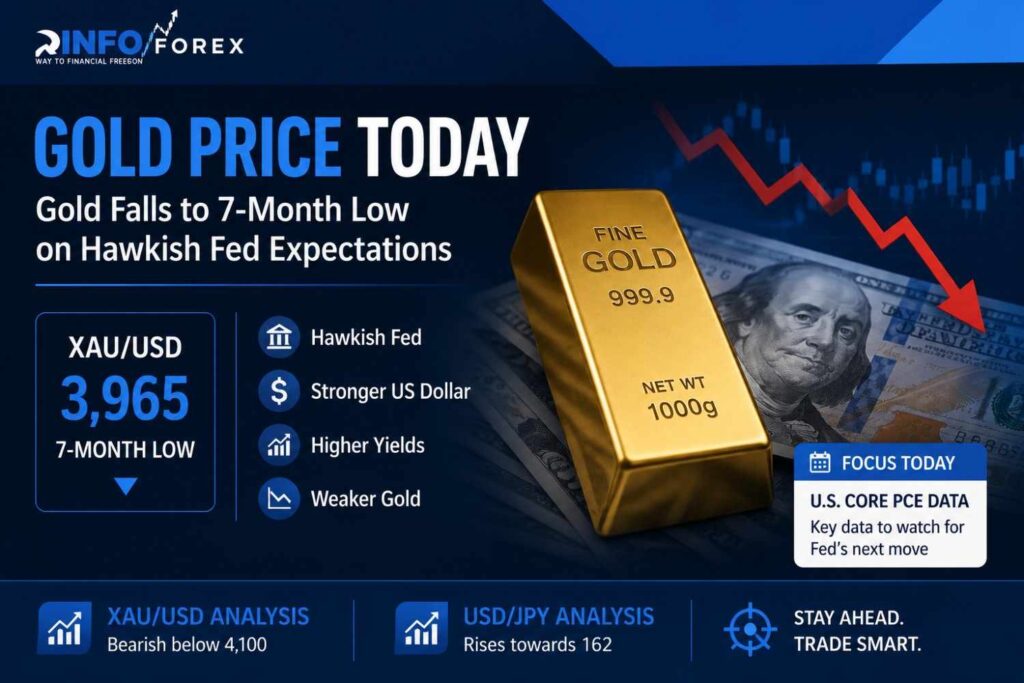
Gold prices (XAU/USD) recovered from their lowest level since November 2025 during Tuesday’s Asian session, moving higher as European trading began. Despite the bounce, the broader outlook remains cautious as a stronger US Dollar continues to weigh on the precious metal.
The US Dollar remains well supported after geopolitical developments in the Middle East and growing expectations that the Federal Reserve could keep interest rates higher for longer. Since gold does not generate interest, rising rate expectations often reduce its appeal compared with yield-bearing assets.
Reports indicated that the United States and Iran were working to reduce tensions after recent military exchanges near the Strait of Hormuz. US President Donald Trump also stated that Iran had requested a meeting in Doha, Qatar. However, Iranian officials denied that any formal technical discussions were scheduled this week. These mixed developments have kept investors alert, supporting demand for the US Dollar while limiting gold’s upside.
Markets also remain focused on inflation risks, which have increased following renewed tensions in the region. Combined with the Federal Reserve’s firm stance on monetary policy, investors continue to expect the possibility of additional rate hikes. Current market pricing suggests there is a strong chance of another rate increase later this year, helping maintain support for the US Dollar and reducing demand for non-yielding assets such as gold.
The Japanese Yen also weakened sharply against the US Dollar, reaching its lowest level in decades, adding further pressure across precious metal markets.
Investors are now watching several important US economic releases, including the Conference Board Consumer Confidence Index and the JOLTS Job Openings report. Later this week, attention will shift to Federal Reserve Chair Kevin Warsh’s speech at the European Central Bank Forum in Sintra, followed by the closely watched US Nonfarm Payrolls (NFP) report. These events could provide fresh direction for both the US Dollar and gold prices.
Technical Analysis
Gold remains under pressure despite Tuesday’s recovery. The price continues to trade below the key $4,000 level, keeping the short-term bearish trend intact. Previous attempts to move above the 100-period Simple Moving Average on the four-hour chart have repeatedly failed, reinforcing resistance in the higher price zone.
The MACD indicator remains slightly below the zero line, suggesting bearish momentum is easing but has not yet turned positive. Meanwhile, the Relative Strength Index (RSI) is hovering near oversold territory, indicating that selling pressure may be slowing, although there is still no confirmed signal of a bullish reversal.
On the upside, immediate resistance is seen around $4,045. A sustained move above this level could allow gold to retest the $4,100 area. However, stronger resistance is expected near the 100-period SMA around $4,180, where sellers may re-enter the market. A decisive break above that level would be needed to improve the overall technical outlook.
Until then, rallies are likely to face selling pressure, while the combination of a firm US Dollar and expectations of higher US interest rates continues to limit gold’s recovery.